Saturday, November 6, 2010

Jill Clayburgh (April 30, 1944 – November 5, 2010)


Jill Clayburgh (April 30, 1944 – November 5, 2010) was an American actress.

Clayburgh was born in New York City, the daughter of Julia Louise (née Dorr), a theatrical production secretary for David Merrick, and Albert Henry "Bill" Clayburgh, a manufacturing executive. Her paternal grandmother was concert and opera singer Alma Lachenbruch Clayburgh.

Clayburgh's father's family was Jewish and wealthy; she was raised in a "fashionable" neighborhood on Manhattan's Upper East Side, where she attended the prestigious Brearley School. Clayburgh attended Sarah Lawrence College, where she decided that she wanted to be an actress.

Clayburgh married screenwriter and playwright David Rabe in 1979. They had one son, Michael Rabe and one daughter, actress Lily Rabe.

Clayburgh joined the Charles Street Repertory Theater in Boston. She appeared in numerous Broadway productions in the 1960s and 1970s, including The Rothschilds and Pippin. Clayburgh made her screen debut in The Wedding Party, filmed in 1963 but not released until six years later, and gained attention with roles such as that of Gene Wilder's love interest in the 1976 comedy-mystery Silver Streak, co-starring Richard Pryor.

She was nominated for the Academy Award for Best Actress for 1978's An Unmarried Woman, for which she won the "Best Actress Award" at the Cannes Film Festival, and for 1979's Starting Over, a comedy with Burt Reynolds. She also received strong notices for a dramatic performance in I'm Dancing as Fast as I Can (which co-starred Geraldine Page).


Her other films include Portnoy's Complaint, Gable and Lombard (in which she portrayed screen legend Carole Lombard), as a pro football team owner's daughter in Semi-Tough, as a mathematician in It's My Turn (in which she teaches the proof of the snake lemma), as a conservative Supreme Court justice in First Monday in October and in Bernardo Bertolucci's controversial La Luna, a role in which her character masturbates her son in an attempt to ease his withdrawal from heroin.

Television audiences know Clayburgh from numerous roles in series and movies including Law and Order, The Practice and as Ally McBeal's mother. She received Emmy Award nominations for her work in the made-for-television movie Hustling in 1975 and for guest appearances in the series Nip/Tuck in 2005.

In 2006, she appeared on Broadway in Neil Simon's Barefoot in the Park with Patrick Wilson and Amanda Peet; she played Peet's mother, a role originated by Mildred Natwick. She also returned to the screen as a therapist's eccentric wife in the all-star ensemble dramedy Running With Scissors, an autobiographical tale of teenage angst and dysfunction based on the book by Augusten Burroughs. During 2007, Clayburgh appeared in the ABC television series Dirty Sexy Money, playing Letitia Darling.

Jill Clayburgh survived chronic lymphocytic leukemia for more than two decades. She died at her home during the morning hours of November 5, 2010, surrounded by her family.

Thursday, November 4, 2010

Loretta Swit (born November 4, 1937)


Loretta Swit (born November 4, 1937)
is best-known for her portrayal of Major Margaret "Hot Lips" Houlihan on M*A*S*H.
When Swit arrived in Hollywood in 1970, she performed in television shows, including Gunsmoke, Mission: Impossible, Hawaii Five-O, and Mannix.

Starting in 1972, Swit played Major Margaret "Hot Lips" Houlihan in the television series M*A*S*H. She inherited the star-making role from actress Sally Kellerman, who portrayed Houlihan in the feature film. Swit, Alan Alda, Jamie Farr, and William Christopher stayed for all 11 seasons of the show, from 1972 to 1983.

She and Alda were the only two actors to have been on the pilot episode and the finale; she appeared in all but 11 of the total of 251 episodes. Swit received two Emmy Awards for her work on M*A*S*H. Later, she was also the first M*A*S*H star to visit South Korea, when she narrated the documentary Korea, the Forgotten War.

In 1981, Swit played the "Cagney" role in the movie pilot for the television series Cagney & Lacey, but was precluded by contractual obligations from continuing the role. Actress Meg Foster portrayed Cagney for the first six episodes of the television series with Sharon Gless taking over the role from that point on.


Swit also guest-starred in shows such as The Love Boat, Match Game, Pyramid, and Hollywood Squares. She also starred in Christmas programs such as the television version of The Best Christmas Pageant Ever and 1987's PBS Special A Christmas Calendar. Loretta's latest appearance was on GSN Live on October 10, 2008.

Swit married actor Dennis Holahan in 1983 and divorced him in 1995. Holahan played Per Johannsen, a Swedish diplomat who became briefly involved with Swit's character in an episode of M*A*S*H. Swit has not remarried and has no children.


Swit has written a book on needlepoint (A Needlepoint Scrapbook). Swit is a very strong advocate for animals and animal rights, donating much of her time to animal-related causes.


Tuesday, November 2, 2010

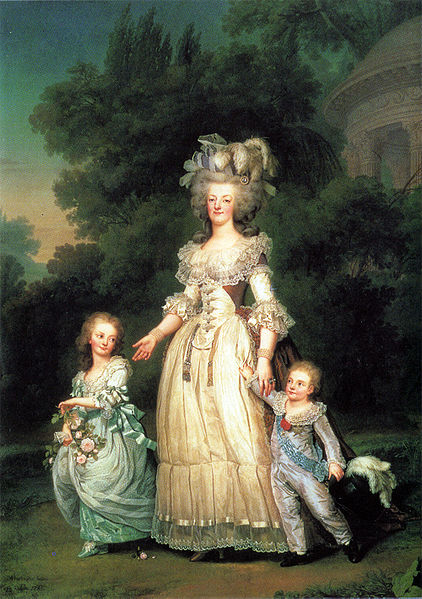
Marie Antoinette - 2 Nov 1755 - 16 Oct 1793


Marie Antoinette (Maria Antonia Josepha Johanna; 2 November 1755 – 16 October 1793) was an Archduchess of Austria and the Queen of France and of Navarre. She was the fifteenth and penultimate child of Empress Maria Theresa of Austria and Emperor Francis I.

At the age of fourteen, on the day of her marriage to Louis-Auguste, Dauphin of France, she became Dauphine de France. At the death of King Louis XV, in May 1774, her husband ascended the throne of France as King Louis XVI, and Marie Antoinette assumed the title of Queen of France and of Navarre. After seven years of marriage she gave birth to a daughter, Marie-Thérèse Charlotte, the first of their four children.

Initially charmed by her personality and beauty, the French people generally came to dislike her, accusing "the Austrian" of being profligate, promiscuous, and harboring sympathies for France's enemies.


At the height of the French Revolution, Louis XVI was deposed and the royal family was imprisoned. Nine months after her husband's execution, she was tried, convicted of treason, and executed by guillotine on 16 October 1793.

Louis was executed on 21 January 1793, at the age of thirty-eight. The result was that the "Widow Capet", as the former queen was called after the death of her husband, plunged into deep mourning; she refused to eat or do any exercise. There is no knowledge of her proclaiming her son as Louis XVII; however, the comte de Provence, in exile, recognised his nephew as the new king of France and took the title of Regent. Marie-Antoinette's health rapidly deteriorated in the following months. By this time she suffered from tuberculosis and possibly uterine cancer, which caused her to haemorrhage frequently.

Despite her condition, the debate as to her fate was the central question of the National Convention after Louis's death. There were those who had been advocating her death for some time, while some had the idea of exchanging her for French prisoners of war or for a ransom from the Holy Roman Emperor. Thomas Paine advocated exile to America. Starting in April, however, a Committee of Public Safety was formed, and men such as Jacques Hébert were beginning to call for Antoinette's trial; by the end of May, the Girondins had been chased out of power and arrested. Other calls were made to "retrain" the Dauphin, to make him more pliant to revolutionary ideas. This was carried out when the eight year old boy Louis Charles was separated from Antoinette on 3 July, and given to the care of a cobbler. On 1 August, she herself was taken out of the Tower and entered into the Conciergerie as Prisoner No. 280. Despite various attempts to get her out, such as the Carnation Plot in September, Marie Antoinette refused when the plots for her escape were brought to her attention.


She was finally tried by the Revolutionary Tribunal on 14 October. Unlike the king, who had been given time to prepare a defence, the queen's trial was far more of a sham, considering the time she was given (less than one day) and the Jacobins' misogynistic view of women in general. Among the things she was accused of (most, if not all, of the accusations were untrue and probably lifted from rumours begun by libelles) were orchestrating orgies in Versailles, sending millions of livres of treasury money to Austria, plotting to kill the Duke of Orléans, incest with her son, declaring her son to be the new king of France and orchestrating the massacre of the Swiss Guards in 1792.

The most infamous charge was that she sexually abused her son. This was according to Louis Charles, who, through his coaching by Hébert and his guardian, accused his mother. After being reminded that she had not answered the charge of incest, Marie Antoinette protested emotionally to the accusation, and the women present in the courtroom – the market women who had stormed the palace for her entrails in 1789 – ironically began to support her. She had been composed throughout the trial until this accusation was made, to which she finally answered, "If I have not replied it is because Nature itself refuses to respond to such a charge laid against a mother."

However, in reality the outcome of the trial had already been decided by the Committee of Public Safety around the time the Carnation Plot was uncovered, and she was declared guilty of treason in the early morning of 16 October, after two days of proceedings. Back in her cell, she composed a moving letter to her sister-in-law Madame Élisabeth, affirming her clear conscience, her Catholic faith and her feelings for her children. The letter did not reach Élisabeth.


On the same day, her hair was cut off and she was driven through Paris in an open cart, wearing a simple white dress. At 12:15 pm, two and a half weeks before her thirty-eighth birthday, she was executed at the Place de la Révolution (present-day Place de la Concorde). Her last words were, "Pardon me Sir, I meant not to do it", to Sanson the executioner, whose foot she had accidentally stepped on before she was executed by guillotine. Her body was thrown into an unmarked grave in the Madeleine cemetery, rue d'Anjou, (which was closed the following year).

Her sister-in-law Élisabeth was executed in 1794 and her son died in prison in 1795. Her daughter returned to Austria in a prisoner exchange, married and died childless in 1851.


Both her body and that of Louis XVI were exhumed on 18 January 1815, during the Bourbon Restoration, when the comte de Provence had become King Louis XVIII. Christian burial of the royal remains took place three days later, on 21 January, in the necropolis of French Kings at the Basilica of St Denis.

In popular culture, the phrase "Let them eat cake" is often attributed to Marie Antoinette. However, there is no evidence to support that she ever uttered this phrase, and it is now generally regarded as a "journalistic cliché". It originally appeared in Book VI of the first part (finished in 1767, published in 1782) of Rousseau's putative autobiographical work, Les Confessions.

Monday, November 1, 2010

James MacArthur (Dec 8, 1937 – Oct 28, 2010)


James Gordon MacArthur (December 8, 1937 – October 28, 2010)


James was an American actor best known for the role of Danny "Danno" Williams, the reliable second-in-command of the fictional Hawaiian State Police squad Hawaii Five-O.

In 1967, Leonard Freeman, the producer of Hang 'Em High, made the pilot for a new television cop show, Hawaii Five-O. Before it went to air, the pilot was well-received by test audiences, except for some dislike of the actor playing Dan Williams. Freeman remembered MacArthur's portrayal of the traveling preacher in Hang 'Em High: He had come on the set and done the scene in one take. He called MacArthur and offered him the role of Dan Williams. Hawaii Five-O ran for twelve years — eleven with MacArthur. Leaving Hawaii Five-O at the end of its eleventh season, MacArthur returned to the theatre, appearing in The Lunch Hour with Cybill Shepherd.

He appeared in A Bedfull of Foreigners in Chicago in 1984, and in Michigan in 1985. He followed this with The Hasty Heart, before taking a year out of show business. In 1987, he returned to the stage in The Foreigner, then played Mortimer in the national tour of Arsenic and Old Lace with Jean Stapleton, Marion Ross and Larry Storch. In 1989, he followed another stint in The Foreigner with Love Letters and, in 1990–1991, A Bedfull of Foreigners, this time in Las Vegas.

After leaving Hawaii Five-O, McArthur guest-starred on such television shows as Murder, She Wrote, The Love Boat, Fantasy Island and Vega$, as well as in the mini series Alcatraz: The Whole Shocking Story and The Night the Bridge Fell Down, and in the 1998 television movie Stormchasers: Revenge of the Twister, with Kelly McGillis.

Throughout his career, MacArthur had also found time for various other ventures. From 1959–60, he partnered with actor James Franciscus and Alan Ladd, Jr. in a Beverly Hills telephone answering service; in June 1972, he directed The Honolulu Community Theatre in a production of his father's play The Front Page, and, for a period in the 1990s he was part-owner of Senior World publication, as well as writing the occasional celebrity interview. In 2000 MacArthur was awarded his own "sidewalk star" in Palm Springs. He continued to appear at conventions, collectors' shows, and celebrity sporting events. A keen golfer, he was the winner of the 2002 Frank Sinatra Invitational Charity Golf Tournament.


He also appeared in television and radio specials and interview programs. His most recent appearances include spots on Entertainment Tonight, Christopher's Closeup and the BBC Radio 5 Live obituary program Brief Lives, in which he paid tribute to his Hawaii Five-O castmate, the late Kam Fong. In 1997, MacArthur returned without Jack Lord (who was in declining health) to play Governor Danny Williams in the 1997 unaired pilot of Hawaii Five-O which starred actor Gary Busey. In April 2003, he traveled to Honolulu's historic Hawaii Theatre for a cameo role in Joe Moore's play Dirty Laundry. Negotiations were underway in late 2010 for MacArthur to make a cameo appearance in the new CBS prime time remake of Hawaii Five-0 at the time of his death.

MacArthur died of natural causes on October 28, 2010, age 72, at the Mayo Clinic in Jacksonville, Florida. He was survived by his third wife, H. B. Duntz, and his four children and six grandchildren.

Sunday, October 31, 2010

John Candy - Oct 31, 1950 - March 4, 1994


John Franklin Candy (October 31, 1950 – March 4, 1994):
John Candy was a Canadian actor and comedian. He rose to fame as a member of the Toronto, Ontario branch of The Second City, its related Second City Television series, and in his role in comedy films such as Stripes, Splash, Cool Runnings, The Great Outdoors, and Uncle Buck. One of his most renowned onscreen performances was that of Del Griffith, the loquacious, homeless shower curtain ring salesman in the John Hughes comedy Planes, Trains and Automobiles.


Candy was born in Newmarket, Ontario, the son of Evangeline (née Aker) and Sidney James Candy. He was raised in the working-class Roman Catholic family.[3] Candy attended Neil McNeil High School, an all-boys Catholic school in Toronto, where he played Canadian football.

Candy's first movie role was a small uncredited appearance in the 1973 film Class of '44. He appeared in several other low-budget films in the 1970s. In 1976, Candy played a supporting role (with Rick Moranis) on Peter Gzowski's short-lived, late-night television talk show, Ninety Minutes Live. That same year, as a member of Toronto's branch of The Second City,[4] he gained wide North American popularity, which grew when he became a cast member on the influential Toronto-based comedy-variety show Second City Television (SCTV). NBC picked the show up in 1981 and it quickly became a fan favorite.

Among Candy's memorable characterizations for SCTV were unscrupulous street-beat TV personality Johnny LaRue, 3-D horror auteur Doctor Tongue, sycophantic and easily amused talk-show sidekick William B. Williams, and Melonville's corrupt Mayor Tommy Shanks. Other characters included Morgy, from Morgy and Shoo, the cheerful Leutonian clarinetist Yosh Shmenge, who was half of the Happy Wanderers and the subject of the mockumentary The Last Polka, folksy fishin' musician Gil Fisher, handsome if accent-challenged TV actor Steve Roman, hapless children's entertainer Mr. Messenger, corrupt soap opera doctor William Wainwright, and smut merchant Harry, "the Guy With the Snake on His Face".


Mimicry was one of Candy's talents, which he used often at SCTV. Celebrities impersonated by Candy include Jerry Mathers, Divine (Glen Milstead), Orson Welles, Julia Child, Richard Burton, Darryl Sittler, Luciano Pavarotti, Jimmy the Greek, Andrew Sarris, Tip O'Neill, Don Rickles, Curly Howard, Merlin Olsen, Jackie Gleason, Tom Selleck, Gordon Pinsent, Ed Asner, Gertrude Stein, Morgy Kneele, Doug McGrath, and Hervé Villechaize.

By 1980, he began a more active film career having appeared as a soldier in Steven Spielberg's big-budget comedy 1941 and had a supporting role as Burton Mercer, "Joliet" Jake's correctional officer in The Blues Brothers. A year later, Candy played the lovable, mild-mannered Army recruit Dewey Oxberger in 1981's Stripes, one of the most successful films of the year. In the next two years, Candy did a small cameo in Harold Ramis' National Lampoon's Vacation, appeared on Saturday Night Live twice (hosting in 1983), while still appearing on SCTV.

In 1983, Candy headlined in the film Going Berserk, and was also approached to play the character of accountant Louis Tully in Ghostbusters (completed and released 1984), but ultimately did not get the role because of his conflicting ideas of how to play the character; the part went instead to Rick Moranis (however, Candy was one of the many celebrities who appeared chanting "Ghostbusters" in Ray Parker, Jr.'s hit "single" for the movie). In 1984, Candy played Tom Hanks' womanizing brother in the hit romantic comedy Splash, considered to be his breakout role.

Throughout the latter half of the 1980s, Candy worked often taking roles in substandard films (even performing the voice of a talking horse in the Bobcat Goldthwait comedy Hot to Trot). Although Candy continued to play supporting roles in films like Spaceballs, he was awarded the opportunity to headline or co-star in such comedy films as Volunteers; Planes, Trains & Automobiles; Brewster's Millions; The Great Outdoors; Armed and Dangerous; Who's Harry Crumb?, Summer Rental and Uncle Buck. He also continued to provide memorable bit roles, including a "weird" disc jockey in the comic musical film Little Shop of Horrors, and a state trooper in the Sesame Street film Follow That Bird.


He also produced and starred in a Saturday morning animated series on NBC entitled Camp Candy in 1989. The show was set in a fictional summer camp run by Candy, featured his two children in supporting roles, and also spawned a brief comic book series published by Marvel Comics' Star Comics imprint.

In the early 1990s, Candy's career went into decline after he appeared in a string of critical and commercial failures, including Nothing But Trouble (for which he was nominated for a Razzie as "worst supporting actress", playing a woman), Delirious, and Once Upon A Crime, although he did appear in major successes such as Rookie of the Year (uncredited), The Rescuers Down Under, Cool Runnings, and Home Alone.

Candy attempted to reinvigorate his acting career by broadening his range and playing more dramatic roles. In 1991, Candy appeared in a light romantic comedy-drama, Only the Lonely which saw him as a Chicago cop torn between his overbearing mother (Maureen O'Hara) and his new girlfriend (Ally Sheedy). The same year and in rare form, Candy played a dramatic role as Dean Andrews Jr., a shady Southern lawyer in Oliver Stone's JFK.

In 1991, Bruce McNall, Wayne Gretzky, and Candy became co-owners of the Canadian Football League's Toronto Argonauts. The celebrity ownership group attracted a lot of attention in Canada and the team spent a significant amount of money, even signing some highly touted National Football League players. John and the Argonauts took home the 1991 Grey Cup beating Calgary 36-21 in the final.


Candy struggled with obesity throughout his adult life. During the late 1980s and early 1990s he gained a large amount of additional weight, though he had been making a significant effort to improve his overall health in the last year of his life; he had quit smoking and had begun losing some weight. However, while on location in Durango, Mexico, filming Wagons East!, Candy died in his sleep from a heart attack on March 4, 1994 at the age of 43. His funeral was held at St. Martin of Tours Church. Candy was interred in the mausoleum at Holy Cross Cemetery in Culver City, California.

On March 18, 1994, a special memorial service for Candy, produced by his former improv troupe The Second City, was broadcast across Canada.[ Following his death, the sign atop comedy club The Laugh Factory honored Candy and fellow comedian Bill Hicks (who had died several days earlier): "Rest in peace; make God laugh."

Wagons East! was released in the summer of 1994, completed using a body double in Candy's place.

Candy's final completed movie was Canadian Bacon, a satirical comedy by Michael Moore that was released the year after Candy's death. Candy played American sheriff Bud Boomer who led the "attack" against Canada.

Candy recorded a voice for the TV film The Magic 7 in the early-1990s. The film remained in production for years due to animation difficulties and production delays, and it was shelved.

Candy was inducted into Canada's Walk of Fame. In May 2006, Candy became one of the first four entertainers ever honoured by Canada Post by being featured on a postage stamp. Blues Brothers 2000 is dedicated to three people, including Candy, who played a supporting role in the original Blues Brothers.

The John Candy Visual Arts Studio at Neil McNeil Catholic High School, in Toronto, Ontario was dedicated in his honour after his death. John Candy, one of the school's most famous alumni, said during one of his annual visits to the school, “My success is simply rooted in the values and discipline and respect for others that I was taught at Neil McNeil.”


A tribute to Candy was hosted by Dan Aykroyd at the 2007 Grey Cup festivities in Toronto in November 2007.

Ween's Chocolate and Cheese album released in 1994 is "dedicated in loving memory to John Candy (1950-1994)".


Tuesday, August 3, 2010

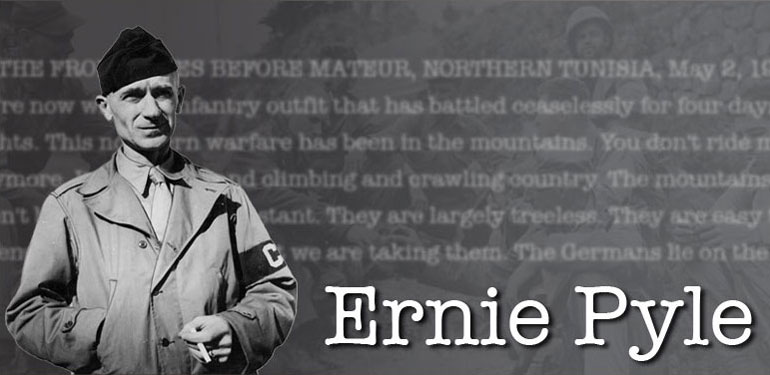
Ernie Pyle (August 3, 1900 – April 18, 1945)


Ernest Taylor Pyle (August 3, 1900 – April 18, 1945) was an American journalist who wrote as a roving correspondent for the Scripps Howard newspaper chain from 1935 until his death in combat during World War II. He won the Pulitzer Prize in 1944. His articles, about the out-of-the-way places he visited and the people who lived there, were written in a folksy style, much like a personal letter to a friend. He enjoyed a following in some 300 newspapers.

Following the entry of the U.S. into World War II, Pyle became a war correspondent, applying his intimate style to the war. Instead of the movements of armies or the activities of generals, Pyle generally wrote from the perspective of the common soldier, an approach that won him not only further popularity but also the Pulitzer Prize. Among his most widely read and reprinted columns is "The Death of Captain Waskow." His wartime writings are preserved in four books: Ernie Pyle In England, Here Is Your War, Brave Men, and Last Chapter.

After his return for a vacation, he wrote to his college roommate, Paige Cavanaugh: "Geraldine was drunk the afternoon I got home. From there she went on down. Went completely screwball. One night she tried the gas. Had to have a doctor." The two were divorced on April 14, 1942, and remarried by proxy while Pyle was in Africa on March 10, 1943. In 1944, he wrote a column urging that soldiers in combat get "fight pay" just as airmen were paid "flight pay." Congress passed a law authorizing $10 a month extra pay for combat infantrymen. The legislation was called "The Ernie Pyle bill."

He reported from the United States, Europe, Africa, and the Pacific. His reporting was interrupted several times by leaves to return home to care for Jerry while they were still married and to recuperate from the stresses of combat, including nearly being killed in the accidental bombing by the Army Air Forces at the onset of Operation Cobra near Saint-Lô in Normandy in July 1944. Pyle publicly apologized to his readers in a column on September 5, 1944, that he had "lost track of the point of the war", and that another two weeks of coverage would have seen him hospitalized with a war neurosis. He hoped that a rest in his home in New Mexico would restore his vigor to go "warhorsing around the Pacific".

When Pyle decided to cover events in the Pacific, he butted heads with the U.S. Navy over its policy forbidding the use of the actual names of sailors in his reports and won an unsatisfying partial victory in that the ban was lifted only for him. His first cruise was aboard the aircraft carrier USS Cabot, in which he saw an "easy life" in comparison to the infantry in Europe, resulting in several unflattering portraits of the Navy. Pyle was soon criticized by fellow correspondents, newspaper editorials, and G.I.s for giving apparent short shrift to the difficulties of the war in the Pacific. During the tiff he admitted that his heart was with the infantrymen in Europe, but he persevered to report on their efforts during the invasion of Okinawa. He was noted for having premonitions of his own death and predicted before landing that he would not be alive a year hence.

On April 18, 1945, Pyle died on Ie Shima, an island off Okinawa Honto, after being hit by Japanese machine-gun fire. He was travelling in a jeep with Lieutenant Colonel Joseph B. Coolidge (commanding officer of the 305th Infantry Regiment, 77th Infantry Division) and three other men. The road, which ran parallel to the beach two or three hundred yards inland, had been cleared of mines, and hundreds of vehicles had driven over it. As the vehicle reached a road junction, an enemy machine gun located on a coral ridge about a third of a mile away began firing at them. The men stopped their vehicle and jumped into a ditch. Pyle and Coolidge raised their heads to look around for the others; when they spotted them, Pyle smiled and asked Coolidge "Are you all right?" Those were his last words. The machine gun began shooting again, and Pyle was struck in the left temple (however, the Ernie Pyle State Historic Site in Dana, Indiana, contains a telegram from the Government to Pyle's father stating Pyle was killed by a sniper).The colonel called for a medic, but none were present. It made no difference—Pyle had been killed instantly.

He was buried with his helmet on, laid to rest in a long row of graves among other soldiers, with an infantry private on one side and a combat engineer on the other. At the ten-minute service, the Navy, Marine Corps, and Army were all represented. Pyle was later reburied at the Army cemetery on Okinawa, then moved to the National Memorial Cemetery of the Pacific located in Honolulu. When Okinawa was returned to Japanese control after the war, the Ernie Pyle monument was one of only three American memorials allowed to remain in place. Pyle was among the few American civilians killed during the war to be awarded the Purple Heart.